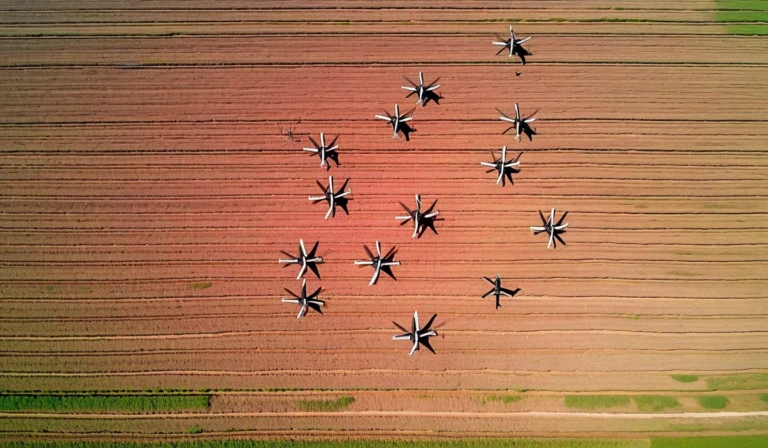
Drone swarms generated enormous theoretical interest for years before field deployments gave us real data on what the technology actually does — and more importantly, what it doesn't do yet. Recent operational use of coordinated multi-drone systems has clarified the landscape considerably. Some of the excitement was warranted. Some of it wasn't.
What we've learned from observing real deployments is that swarm technology is neither the decisive war-winning capability that advocates claimed nor the overrated science project that skeptics described. It's a genuinely powerful capability with specific operational envelopes and specific technical gaps that define where the investment opportunities actually are.
What "Contested Airspace" Means for Swarms
Drone swarms have been demonstrated in controlled environments and in permissive airspace. Operating in genuinely contested airspace — where adversary forces have electronic warfare, kinetic anti-drone systems, and air defense assets actively trying to degrade the swarm — introduces constraints that lab results don't capture.
The primary challenge is communications architecture. Most swarm coordination relies on radio communication between nodes for real-time position sharing and mission updates. That communication is a vulnerability. GPS jamming degrades position awareness. Radio frequency interference degrades inter-drone communication. An adversary who can disrupt either of those channels can fragment a swarm from a coordinated capability into a collection of uncoordinated individual vehicles.
This is not an abstract concern. Electronic warfare systems capable of degrading swarm communications are commercially available and actively proliferating. Any swarm investment thesis that doesn't address contested communications environments is incomplete.
The Three Investment Signals We've Identified
Based on what we've seen in the field and in our diligence on active programs, three technical characteristics separate companies building durable capability from those building capability that will underperform at the moment it matters.
Resilient swarm autonomy. Swarms that can continue coordinated operations when communication is degraded — using onboard sensor data and pre-loaded mission parameters rather than real-time commands — have a qualitatively different capability profile than communication-dependent swarms. The algorithmic challenge here is significant: maintaining emergent coordination behavior without centralized communication is an unsolved problem in many operational scenarios. Companies with real progress on degraded-mode autonomy are worth serious attention.
Heterogeneous swarm composition. Early swarm concepts imagined uniform vehicles doing the same thing. Operational experience suggests heterogeneous swarms — mixing sensor platforms, electronic warfare assets, strike vehicles, and communication relay nodes — are more capable and harder to counter than uniform swarms. The mission planning software that coordinates heterogeneous swarms is a distinct product category with significant value.
Counter-swarm integration. Every capability generates a counter-capability. Counter-drone systems are a genuine growth market, and the companies that understand both sides of the swarm/counter-swarm equation — and can help customers optimize against adversary tactics — have a more defensible position than pure swarm developers.
The Manufacturing Problem Nobody Talks About
There's a less glamorous challenge that we've seen trip up technically capable swarm companies: unit economics at defense procurement scale.
A swarm that fields 50 vehicles in a demonstration is impressive. A swarm that needs to be deployed, recovered, refurbished, and redeployed at the tempo of actual operations requires a manufacturing and logistics infrastructure that most startups haven't designed for. The DoD has learned from the FPV drone experience in recent conflicts that procurement at meaningful scale requires a supply chain that isn't dependent on a small number of suppliers or components with long lead times.
We ask swarm companies specifically: what's your bill of materials for a 100-vehicle swarm, and which components have supply chain risk? The answers are telling. Companies that have thought carefully about manufacturing — not just technology — tend to have operators or defense industry veterans in the founding team. That's not a coincidence.
The swarm thesis is real. The companies that will actually deliver on it are building for the operational environment — contested, degraded, logistically constrained — not for the demo environment. Finding those companies is harder than it sounds.
Where We're Placing Bets
Our portfolio positioning in unmanned aerial systems reflects these views. We're less interested in vehicle development per se — the basic quadcopter and fixed-wing form factors are commoditized — and more interested in the software layers that determine what a swarm can actually do: mission planning, degraded-mode coordination, heterogeneous fleet management, and counter-swarm decision support.
We're also watching the counter-swarm side of the market closely. Directed energy systems for counter-drone applications, multi-spectral detection, and AI-driven intercept cueing are areas where the U.S. has acknowledged capability gaps and where multiple programs of record are being stood up. The companies that can credibly address both offensive and defensive swarm problems will have broader market access and more resilient revenue profiles than pure-play swarm developers.
The field is maturing. The demos are behind us. What matters now is operational performance in the conditions that actually define whether a capability is real.