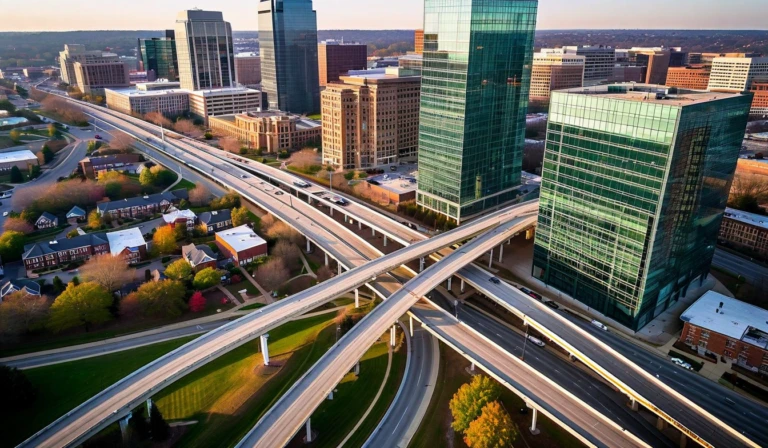
When we tell people Aviataix Ventures is based in Tysons, Virginia, the response from people outside the defense community is usually a question about why — why not Washington, D.C., or Silicon Valley, or Austin? The people who've spent careers in defense technology understand immediately. Tysons has become, over the last two decades, one of the most important physical addresses in defense investment. The reason isn't marketing; it's geography, talent, and institutional concentration.
The Proximity Argument
Defense investment has a proximity requirement that commercial venture capital doesn't. The government customers that matter — the program offices, the acquisition authorities, the operational commanders who will ultimately decide whether your technology gets fielded — are clustered in a geographic corridor that runs from the Pentagon through Reston to Fort Belvoir and down toward Quantico.
Tysons sits at the center of that corridor. The Pentagon is 12 miles east. Fort Belvoir is 15 miles south. The intelligence community campuses in Springfield are 10 miles away. NGA headquarters at Springfield is close enough for a working lunch meeting. The concentration of cleared facility space, government contracting offices, and program management infrastructure in Fairfax County is unmatched anywhere in the country outside of the National Capital Region proper.
This matters for defense startups for a specific reason: relationship building in the defense market requires face-to-face time with government customers at a cadence that being in San Francisco simply doesn't support. A defense tech company that needs to make 30 visits per quarter to government program offices will spend a significant fraction of its operating budget on travel if it's based in California. Or it will make fewer visits. Either way, it's at a disadvantage relative to companies in the Tysons-Reston corridor.
The Talent Ecosystem
Tysons has the most concentrated pool of cleared defense technology talent in the United States. The reason is historical: the major defense contractors — SAIC, Leidos, Booz Allen Hamilton, DXC Technology, Northrop Grumman — have maintained major operations in the Tysons-Reston area for decades. The technical workforce that supported those operations is resident in the surrounding communities.
For defense startups, this matters enormously. The cleared software engineers, systems architects, and program managers that defense companies need don't generally relocate from the Northern Virginia suburbs to San Francisco or Austin for startup jobs. They want equity upside, but they're not willing to sell their houses and move their families across the country. The talent market for cleared defense tech professionals is local in a way that consumer tech talent isn't.
We've talked to founders who built technically excellent defense companies in other geographic markets and then hit a growth ceiling because they couldn't hire cleared personnel at the pace required by their program growth. Relocating to the Northern Virginia corridor resolved the problem — but only after they'd paid the cost of building on the wrong foundation in the first place.
Location is a strategic decision for defense companies, not a lifestyle preference. We've seen it matter in ways that are hard to quantify but easy to observe — in meeting frequency, in hiring velocity, in the quality of government relationships that develop from repeated informal contact over time.
The Capital Network
The defense-focused capital base has also concentrated here. In-Q-Tel, the strategic investment arm of the intelligence community, operates from Arlington. Several defense-specialist VC firms have their primary offices in the Tysons-Reston corridor. The angel investor and seed capital community with defense orientation — largely former senior government officials, retired flag officers, and defense industry executives — is heavily concentrated in Northern Virginia.
That concentration has a compounding effect. Defense founders in the Tysons area have regular informal access to investors and advisors who understand their market. They get candid feedback on their government strategies from people who've navigated the same terrain. They build investor relationships through repeated low-stakes interactions before formal fundraising processes begin. All of that is harder to replicate in markets where the defense capital network is thinner.
What This Means for Founders
If you're building a defense technology company and you have flexibility on location, the calculus for being in the Northern Virginia corridor is straightforward. The proximity to government customers, the depth of the cleared talent pool, and the density of relevant investor and advisor relationships compound over time into a durable competitive advantage.
This doesn't mean defense companies can't be built elsewhere — clearly they can be and are. But it means that founders who choose other locations should have specific reasons that outweigh the structural advantages of proximity. Better access to a specialized technical talent pool in a different city, lower cost of operations that extends runway meaningfully, or a customer base that's geographically concentrated elsewhere — these are legitimate reasons. "I prefer the Bay Area culture" generally isn't a sufficient offset.
We've been in Tysons since 2010. The decision wasn't accidental then, and nothing since has made us reconsider it. The geography compounds. So does everything built on top of it.