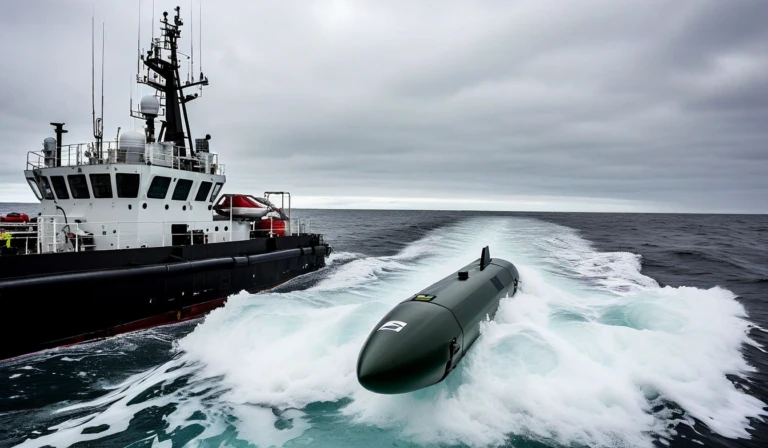
The undersea domain has received a fraction of the investment attention that aerial and ground autonomy have attracted over the last decade. That imbalance isn't an oversight — it reflects genuine technical difficulty. Operating autonomously underwater means working without GPS, with severe communication constraints, in an environment that stresses electronics, materials, and power systems in ways that airborne and ground systems don't experience.
But the strategic importance of the undersea domain is accelerating faster than the investment community has recognized. China's submarine fleet has grown significantly in both quantity and capability. Undersea cable infrastructure — carrying roughly 95% of international data traffic — has become a recognized vulnerability. And the Navy's requirement for persistent undersea surveillance, at a scale that crewed submarines can't achieve, is now driving funded programs that didn't exist five years ago.
What's Changed Technically
Several enabling technologies have matured enough to make AUVs capable of missions they couldn't credibly perform a decade ago.
Energy density. The operational envelope of an AUV is defined almost entirely by its energy storage. Improvements in battery technology — particularly lithium-based chemistries optimized for the depth and temperature range of naval operations — have extended mission endurance from days to weeks on some platforms. That changes the class of missions AUVs can perform, from local survey tasks to persistent surveillance over extended areas.
Acoustic communication advances. Underwater communication uses acoustic modems because radio waves don't propagate through water. The bandwidth and reliability of acoustic communication systems have improved substantially, enabling AUVs to participate in coordinated multi-vehicle operations, relay information to surface or aerial assets, and receive mission updates during deployment. Still a constrained channel compared to RF, but usable in ways it wasn't before.
Autonomous navigation in GPS-denied environments. AUVs have been operating without GPS since the beginning — they've had to. But the quality of inertial navigation, terrain-aided navigation, and geophysical positioning has improved to the point where long-duration autonomous missions with centimeter-level position accuracy are achievable. The algorithms developed for undersea navigation are, incidentally, directly applicable to the GPS-denied ground vehicle problem.
The Mission Categories That Matter
There are four mission categories where AUV capability is creating genuine operational value and corresponding investment opportunity.
Persistent undersea surveillance. The Navy needs to track submarine activity over large ocean areas continuously. Crewed platforms are expensive and limited in number. A distributed network of AUVs, deployed and recovered by surface vessels or submarines, can maintain persistent surveillance coverage that crewed platforms can't. The Orca XLUUV program is the publicly visible leading edge of this requirement, but the demand extends well beyond that single program.
Undersea infrastructure protection. Submarine cables are critical infrastructure with minimal physical protection. AUVs designed for autonomous cable inspection, anomaly detection, and eventually protective response are addressing a requirement that has moved from theoretical to urgent. The incidents involving damage to undersea cables in the Baltic Sea in 2023 and 2024 accelerated defense interest in this mission considerably.
Mine countermeasures. Sea mine clearance has historically required divers or tethered vehicles operating in close proximity to explosive hazards. AUV-based mine hunting and clearance systems remove the human from the immediate threat zone while expanding the area that can be cleared per sortie. Several NATO navies have active procurement programs in this space.
Anti-submarine warfare support. ASW is a manpower and sensor-intensive mission. AUVs operating as mobile sonar nodes — positioned based on threat intelligence, repositioned as the tactical picture evolves — can extend the sensor network of ASW forces in ways that fixed sonar arrays and P-8 aircraft patrols cannot replicate economically.
We've been watching the AUV space for years and waiting for the technical and requirements conditions to align. That alignment is happening now. The window between "technically credible" and "program-of-record saturated" is typically where the best investments occur.
Investment Characteristics
AUV investment has specific characteristics that differ from aerial or ground autonomy investment. The certification and qualification process for undersea systems is less mature than for other domains — there's no FAA equivalent for undersea vehicle certification — which paradoxically makes market entry somewhat easier for novel approaches that don't fit existing certification frameworks.
The customer base is more concentrated than in other defense domains. The Navy and allied navies are the primary buyers, supplemented by commercial undersea infrastructure operators and scientific research institutions. Concentrated customers mean longer sales cycles but, once established, stickier relationships.
The companies we're evaluating most seriously combine strong vehicle platform capability with autonomous mission management software that can direct a distributed fleet of vehicles to accomplish complex tasks. The hardware-software integration in this space is closer than in most autonomy domains — the constraints imposed by the environment force it. That makes the system-level view essential, and it's why the most capable teams are typically those with deep domain experience rather than pure software teams translating from adjacent autonomy domains.